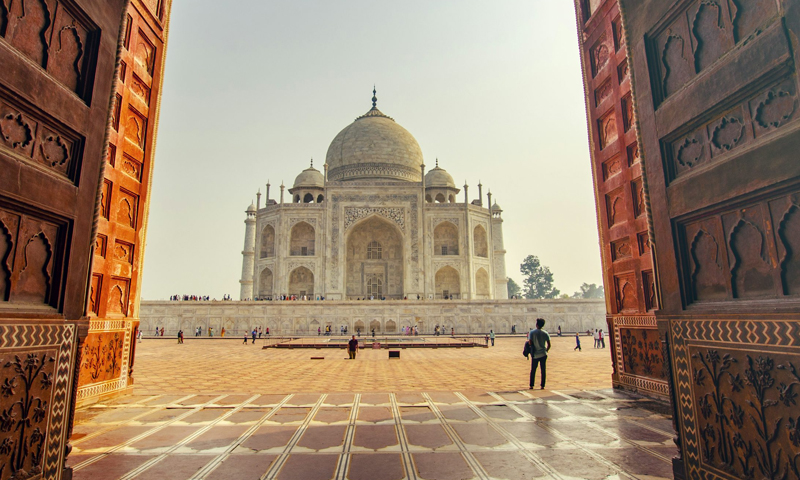



The Taj Mahal is admired worldwide for its beauty, symmetry, and emotional symbolism, yet much of what surrounds this monument goes unnoticed by the majority of visitors. While guidebooks often repeat well-known details about love and marble craftsmanship, the deeper layers of history, engineering, artistry, and planning remain hidden beneath the surface. These lesser-known details transform the Taj Mahal from a famous monument into one of the most technically advanced and culturally layered structures ever created.
Most travelers see the Taj Mahal as a single white marble mausoleum, but in reality, it is a vast architectural complex designed with extraordinary precision. Every element, from its foundation to decorative calligraphy, carries meaning, logic, and advanced scientific understanding that was far ahead of its time. Understanding these hidden aspects allows visitors to appreciate the monument beyond photographs and surface-level narratives.
One of the most surprising facts about the Taj Mahal is that it is not pe6rfectly symmetrical, despite appearing so at first glance. The illusion of symmetry is intentional and carefully engineered. The main structure follows a flawless geometric plan, but the tomb of Emperor Shah Jahan himself disrupts that symmetry.
Originally, only Mumtaz Mahal’s cenotaph was planned to rest at the exact center. Shah Jahan’s burial was added later, positioned slightly off-center. This subtle deviation is almost invisible to casual observers yet represents a rare moment where emotional reality overrode architectural purity.
This imbalance is one of the most fascinating hidden architectural facts about Taj Mahal, demonstrating that even the most precise Mughal designs allowed space for human decisions.
Uncover the fascinating stories, secret spots & lesser-known history of the Taj Mahal with a knowledgeable local guide and comfortable private tour.
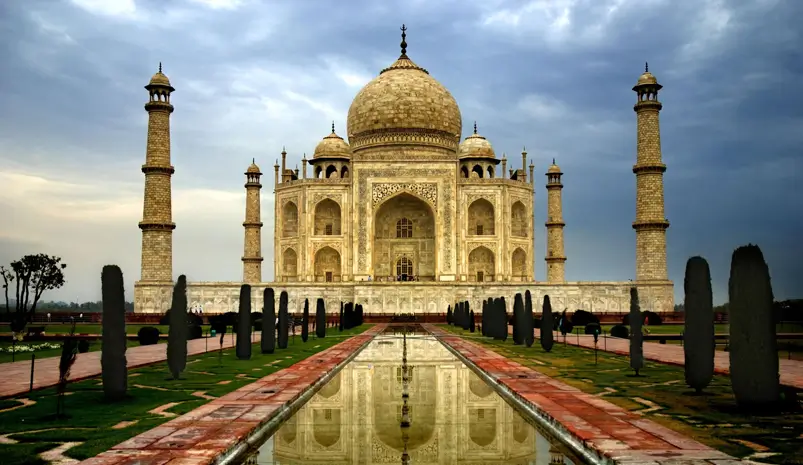
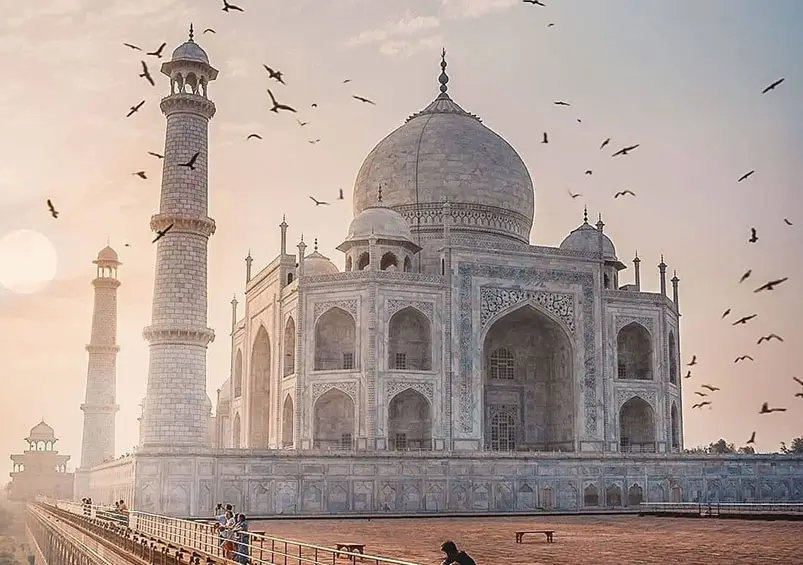
Many visitors notice the four minarets surrounding the main mausoleum but few realize they are built with a slight outward tilt. This was a deliberate engineering decision, not a construction flaw.
In the event of an earthquake or structural collapse, the minarets were designed to fall away from the main tomb, protecting the central structure. This early form of seismic planning shows a deep understanding of structural safety centuries before modern engineering principles were formally established.
The tilted minarets are a strong example of advanced Mughal engineering, blending beauty with practical foresight.
The Taj Mahal appears white, but its color subtly shifts depending on the time of day and lighting conditions. At sunrise, the marble reflects soft pink and golden hues. By midday, it appears bright white, while moonlight gives it a bluish-silver glow.
This phenomenon is not accidental. The marble used in the Taj Mahal has unique reflective qualities, carefully selected to interact with natural light. The monument was designed to mirror the emotional states associated with different times of day, symbolizing life, purity, and eternity.
This color transformation is one of the most photographed yet least explained hidden facts about Taj Mahal marble.
Unlike modern concrete foundations, the Taj Mahal rests on an innovative base system built near the Yamuna River. Engineers used a network of wells filled with stone and timber, creating a stable yet flexible foundation capable of adjusting to soil movement.
Wood was used deliberately because it becomes stronger when submerged in water. The presence of the Yamuna River was not a disadvantage but an essential structural element supporting the monument’s longevity.
This foundation method highlights the extraordinary civil engineering knowledge available during the Mughal era.
The Quranic calligraphy adorning the Taj Mahal looks uniform in size from the ground, but in reality, the inscriptions increase in size as they rise higher. This optical correction ensures visual consistency when viewed from below.
Black marble inlay was used instead of paint, ensuring the calligraphy would never fade. The precision required for this work is astonishing, considering it was done without modern measurement tools.
This visual manipulation technique is one of the most impressive hidden design facts of Taj Mahal.
The Taj Mahal is not made of marble alone. Over 28 types of semi-precious stones were used for inlay work, sourced from regions across Asia and beyond. These include jade from China, turquoise from Tibet, sapphire from Sri Lanka, and lapis lazuli from Afghanistan.
This extensive material sourcing reflects the global trade connections of the Mughal Empire. The floral designs created through pietra dura inlay work are not merely decorative but represent an international fusion of craftsmanship.
Explore hidden facts, local stories and best viewpoints. Customize your Agra visit with private car, driver & expert tour guide.
Most visitors focus on the main mosque to the west of the mausoleum, but few notice the identical structure on the eastern side. This second building, often called the jawab, was built purely for symmetry and balance.
It does not function as a mosque due to its orientation, yet it mirrors the design perfectly. This reflects the Mughal obsession with balance and visual harmony, even when practical use was not required.
The ornate tombs seen by visitors are symbolic cenotaphs. The actual graves of Mumtaz Mahal and Shah Jahan lie in a simple chamber directly below, aligned according to Islamic burial traditions.
Photography is restricted in this inner chamber to preserve the sanctity and silence of the space. This distinction between visible grandeur and hidden simplicity reflects Mughal values of humility in death.
Historical records suggest that the Taj Mahal complex was once surrounded by bustling gardens, caravanserais, and markets. These spaces supported travelers, artisans, and visitors, making the monument part of a living urban environment rather than an isolated structure.
Over time, colonial-era modifications altered the original layout, replacing organic Mughal gardens with formal lawns. Understanding this transformation adds depth to the monument’s historical context.
Unlike many historical structures, the Taj Mahal was designed to be viewed at night. Moonlight visits reveal reflections and shadows that change the monument’s appearance entirely.
The white marble glows softly under moonlight, creating an atmosphere that many historians believe was central to the monument’s emotional impact. This nighttime experience remains one of the most memorable ways to appreciate the Taj Mahal.
A common misconception is that the Taj Mahal was once a palace or residence. It was conceived solely as a mausoleum and ceremonial complex. Every element, from layout to decoration, reinforces themes of eternity, paradise, and remembrance.
Understanding this purpose clarifies why the Taj Mahal feels serene rather than functional.
Post By :- Admin On | 25 Dec 2025
There are sealed chambers and passageways not open to the public, primarily for structural and preservation reasons.
They were designed to fall away from the main structure during earthquakes.
Yes, the marble reflects different hues depending on light and time of day.
Yes, his grave lies beside Mumtaz Mahal in the lower chamber.
Yes, stones were sourced from multiple regions across Asia.
The eastern structure exists for symmetry, not religious use.
Originally, its surroundings enhanced contrast; environmental changes altered perception over time.
No, it is inlaid using black marble.
The actual graves are below the main chamber and not accessible.
Yes, moonlight was an important design consideration.